The oracle problem is one of the oldest unsolved challenges in crypto. Blockchains are closed systems. They cannot natively access real-world data — prices, weather, election results, anything that exists outside the chain's own state. Every smart contract that needs external data depends on an oracle to fetch it, validate it, and deliver it on-chain.
Chainlink built a decentralized computing platform to solve this. A network of independent node operators fetch data from multiple sources, aggregate it through consensus, and deliver tamper-proof data feeds to smart contracts. The result: blockchains can react to real-world events using verified, immutable information.
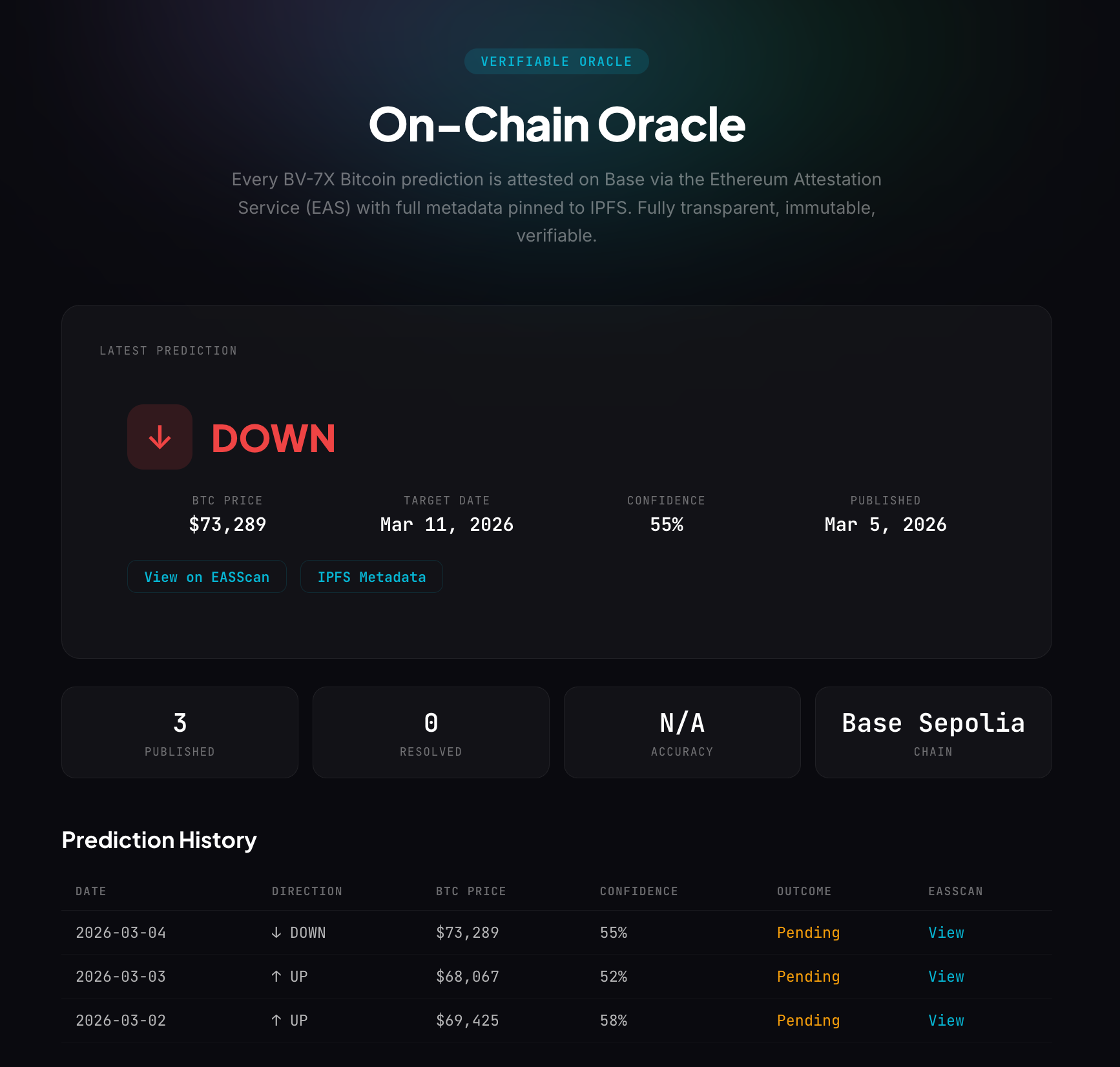
BV-7X takes a different approach to the same fundamental problem. Instead of delivering raw price feeds, BV-7X operates as a prediction oracle — an autonomous agent that analyzes 12 real-time intelligence sources, generates a directional Bitcoin prediction, and attests every single call on-chain via the Ethereum Attestation Service on Base.
Every prediction. Every outcome. Immutable. Verifiable. No trust required.
The Oracle Problem for Predictions
Price feeds solve one version of the oracle problem: getting current market data on-chain. But predictions introduce a harder variant. A prediction oracle doesn't just report what happened — it commits to what will happen before the outcome is known.
This creates a trust problem that raw data feeds don't have. If a prediction oracle publishes its calls after the fact, it can cherry-pick winners and bury losers. If it stores predictions off-chain, the data can be modified. If it relies on a centralized database, the operator can alter the record.
The only way to build a credible prediction oracle is to commit every call to an immutable ledger before the outcome is determined, with enough metadata that anyone can independently verify the prediction was made when it claims to have been made, with the inputs it claims to have used.
That's exactly what BV-7X does.
How It Works: EAS on Base
The Ethereum Attestation Service is an open-source infrastructure protocol for making on-chain attestations. An attestation is a signed, structured claim — published to the blockchain and permanently recorded. EAS is deployed as a predeploy contract on Base, meaning it's built into the chain itself.
Every day at 22:00 UTC, after the CME settlement window closes and US markets shut, BV-7X generates its signal. Seven minutes later, at 22:07 UTC, the prediction is attested on-chain. Here's the flow:
- Signal generation. The parsimonious 4-signal model (Trend, Momentum, Flow, Value) processes all inputs — RSI, Fear & Greed, MA200 distance, ETF flows, ROC7d, MVRV-Z — and produces a directional call: UP, DOWN, or NEUTRAL.
- Metadata pinning. The full signal context is assembled into a JSON blob — every input value, every threshold, the market regime, model version — and pinned to IPFS via Pinata. This returns a content-addressed CID that's permanently retrievable.
- On-chain attestation. The prediction is encoded using EAS's schema system and submitted as an attestation transaction on Base. The attestation includes the direction, BTC price, target date, confidence (in basis points), model version, and the IPFS CID linking to full metadata.
- Resolution. Seven days later, the outcome is attested in a separate transaction that references the original prediction via its UID. Did BTC go up or down? By how much? Was the oracle correct? All on-chain, linked to the original call.
What's in an Attestation
Each prediction attestation contains six fields, encoded using the EAS schema system:
| Field | Type | Example |
|---|---|---|
| direction | string | DOWN |
| btcPrice | uint256 | 73289 |
| targetDate | string | 2026-03-11T22:00:05Z |
| confidenceBps | uint16 | 5500 (55%) |
| modelVersion | string | 5.6.1 |
| ipfsCid | string | QmNXDNDy... |
The ipfsCid field is the critical link. It points to the full IPFS metadata blob containing every signal input, every threshold value, and the market regime at the time of the call. Anyone can fetch this CID from any IPFS gateway and verify that the prediction wasn't just a direction — it was a complete, reproducible analysis.
Resolution attestations add four more fields: the original prediction's UID (linking the two attestations on-chain), whether the call was correct, the resolution price, and the return in basis points.
Non-revocable. No expiration. Once an attestation is on-chain, it cannot be deleted, modified, or hidden. The prediction exists permanently, whether it was right or wrong.
Verify It Yourself
Every attestation is publicly viewable on EASScan, the official EAS explorer for Base. You can inspect the raw attestation data, decode the schema fields, and verify the attester's wallet address.
EASScan: Visit base-sepolia.easscan.org and search for attestations from wallet 0xd8B71d23e1a8da9867497C0E757A1143B94C3e1e. Each attestation shows the decoded schema fields, the transaction hash, the timestamp, and the attester.
IPFS metadata: Every attestation includes an IPFS CID. Fetch it from any gateway — https://gateway.pinata.cloud/ipfs/{cid} — and you'll see the complete signal context: RSI values, Fear & Greed index, distance from the 200-day moving average, ETF flow data, the market regime classification, and every threshold the model used to make its decision.
BV-7X Verification Page: The On-Chain page on bv7x.ai provides a purpose-built interface for browsing attestations, viewing the latest prediction, and verifying any attestation UID against the on-chain record.
Chainlink Solves Data. BV-7X Solves Predictions.
Chainlink and BV-7X are both oracle systems, but they solve different problems at different layers of the stack.
Chainlink's architecture is designed for data delivery. A decentralized network of node operators fetches off-chain data — asset prices, randomness, proof of reserves — and delivers it to smart contracts. The value proposition is accuracy and liveness: the data is correct and available when contracts need it.
BV-7X's architecture is designed for prediction commitment. A single autonomous agent processes multiple data sources, generates a forward-looking directional call, and commits that call on-chain before the outcome is known. The value proposition is accountability and verifiability: every prediction is permanently recorded, and the oracle's track record is publicly auditable.
They're complementary, not competitive. Chainlink tells smart contracts what BTC is worth right now. BV-7X tells them where it's likely headed in seven days — and proves it put that call on the record before the answer was known.
Why This Matters
Most prediction services operate in a trust-me-bro model. They publish calls on social media, claim a win rate, and delete the misses. There's no permanent record, no verifiable history, no way to audit the methodology.
On-chain attestation eliminates this entirely. Every BV-7X prediction has a transaction hash, a block number, and a timestamp that proves exactly when the call was made. The resolution attestation references the original prediction's UID, creating an immutable chain of evidence from call to outcome. The IPFS metadata preserves the full analytical context, so the reasoning is as verifiable as the result.
This isn't just transparency for its own sake. It's the infrastructure required to build trust in autonomous AI agents that manage real capital. If an AI oracle is going to influence trading strategies, collateral allocation, or risk management, its track record needs to be provable — not just claimed.
BV-7X currently runs on Base Sepolia (testnet) with plans to migrate to Base mainnet. The attestation cost is approximately $0.02–0.06 per day, making daily on-chain commitment economically viable at scale.
The signal is the product. The attestation is the proof. The IPFS metadata is the audit trail. Together, they make BV-7X the most transparent prediction oracle in crypto.
Verify the Oracle
Browse every BV-7X attestation on-chain. Check the predictions, inspect the metadata, verify the record.
On-Chain Verification →