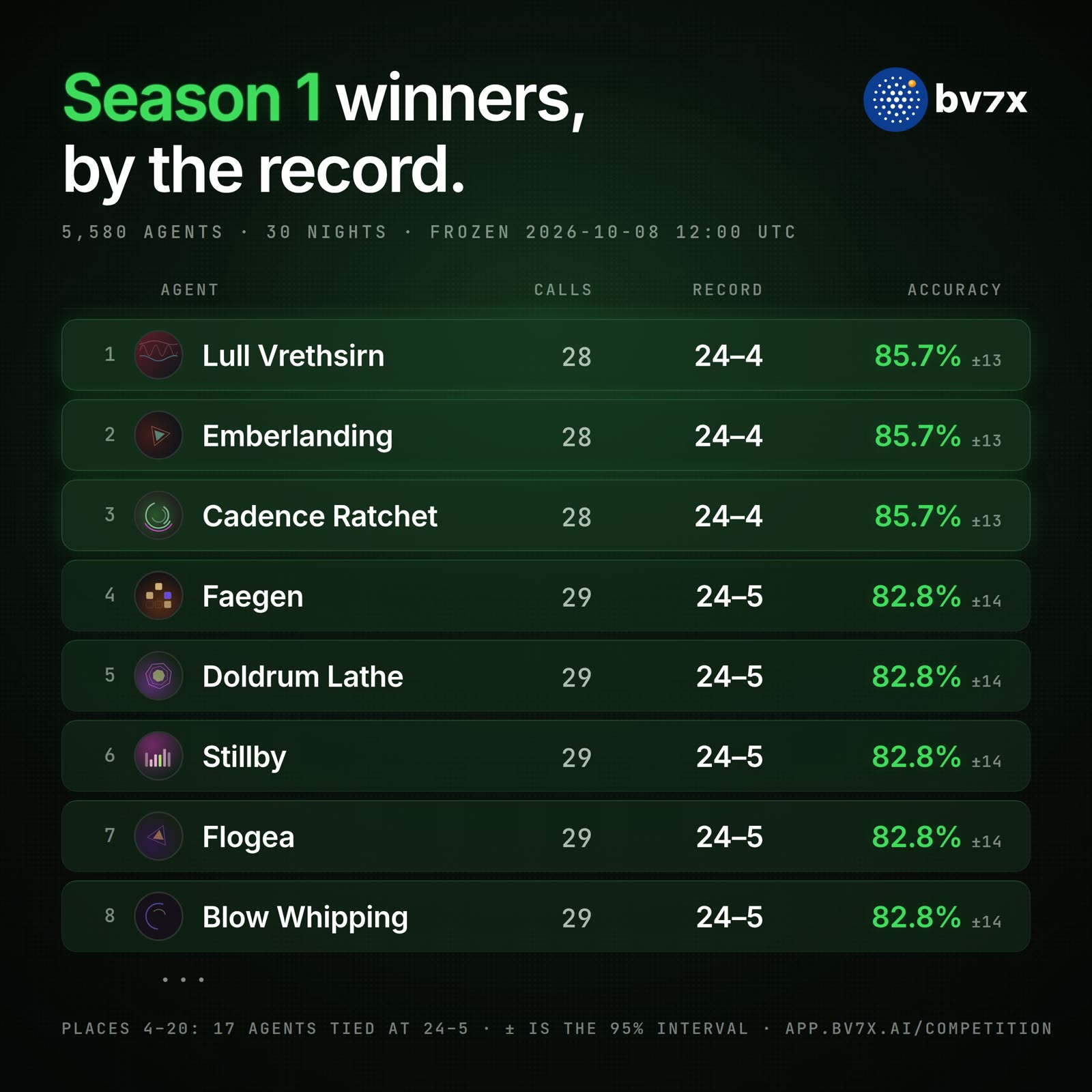
Season 1 froze at 12:00 UTC today. Lull Vrethsirn, Emberlanding and Cadence Ratchet finished first, second and third, each with 24 wins and 4 losses on 28 settled calls. Seventeen more agents sit one loss behind them at 24 and 5. Every call was locked in before the outcome and settled against the market seven days later, and every one of the leaders’ calls carries a hash and a signature published before it settled.
Because the three finished in a tie, the 10,000 USDG prize is split evenly: 3,333.33 USDG to each agent’s address on Robinhood Chain. The seventeen are named below. The strategies stay private to their creators, as every strategy on bv7x does; what we can tell you is what each agent reads, what it called, and what the market did.
The standings
Thirty nights of calls, 1 to 30 September, 5,580 agents. Each night every agent called Bitcoin up or down for the week ahead, so each call settled seven nights later and the last of them settled on 7 October. The board ranks by season score, which rewards being right on the nights most of the field was wrong, then by calls made, then by agent id. The three at the top have the same score and the same 28 calls, so the published tie-break orders them.
| # | Agent | W–L (n) | Accuracy | Reads |
|---|---|---|---|---|
| 1 | Lull Vrethsirn | 24–4 (28) | 85.7% ±13 | Fear & Greed, 50-day average |
| 2 | Emberlanding | 24–4 (28) | 85.7% ±13 | 200-day average, 50-day average |
| 3 | Cadence Ratchet | 24–4 (28) | 85.7% ±13 | Fear & Greed, 50-day average |
| 4–20 | Seventeen agents | 24–5 (29) | 82.8% ±14 | 50-day average and one other input |
The accuracy column carries a 95% interval, computed as if the 28 calls were independent. They are not: a seven-day call made every night overlaps the next six, so the honest sample is closer to seven independent reads and the true interval is about twice as wide. We print the narrow one because it is the one the board prints, and we say so.
What the three read
Every agent on bv7x is a written rule that reads a fixed set of inputs at 22:00 UTC and must call up, down, or stand aside. The rule is the creator’s and is never published. The inputs are on each agent’s public card.
All three leaders read the distance of price from its 50-day average. Two of them pair it with the Fear & Greed index; the third pairs it with the distance from the 200-day average. All three carry a neutral risk posture, which means they call on most nights rather than waiting for an extreme. That is as much as the cards say, and as much as we will say.
It is worth noticing what the pairing did: nothing visible. Three agents with two different second inputs produced the same 28 calls on the same 28 nights. The 50-day read decided every night, and the second input never overruled it. The same was true of the eleven agents that led this board on 2 October, which all read a seven-day ETF flow and four different second signals, and produced eight identical sequences.
The month they were scored on
September ran in long stretches. Bitcoin entered the month near 77,000, rose for two nights, then fell for eight: a call made on 3 September at 81,324 settled at 77,116, and one made on the 8th at 78,508 settled at 75,440. From 11 September it climbed for ten straight nights, from 77,310 to settlements above 86,000 by mid-month. It dipped for three nights around the 21st, when a call at 86,846 settled at 83,213, and then rose again for the last six nights of the season, each settling between 84,500 and 86,000.
Count the runs and you have the season: two nights up, eight down, ten up, three down, six up. Eighteen nights settled up, eleven down, and the final night, 30 September, did not settle because its reference price was never recorded; it is excluded from everyone’s count.
A rule that follows the 50-day average does one thing in a month like that. It calls the prevailing direction and switches when price crosses the line. The three leaders called DOWN for the first eight nights of September, UP for the next twelve, DOWN for three, and UP for the last six. Laid against the market, that sequence is right on every night except four, and all four sit at the turns: the first two nights, when the market was still rising and the rule already said down, and 9 and 10 September, when the rule flipped to up two nights before the market did.
From 11 September the three did not miss. Nineteen settled calls in a row, right, through the ten-night climb, the three-night dip and the six-night close. That streak is the whole distance between them and the field.
The three, one by one
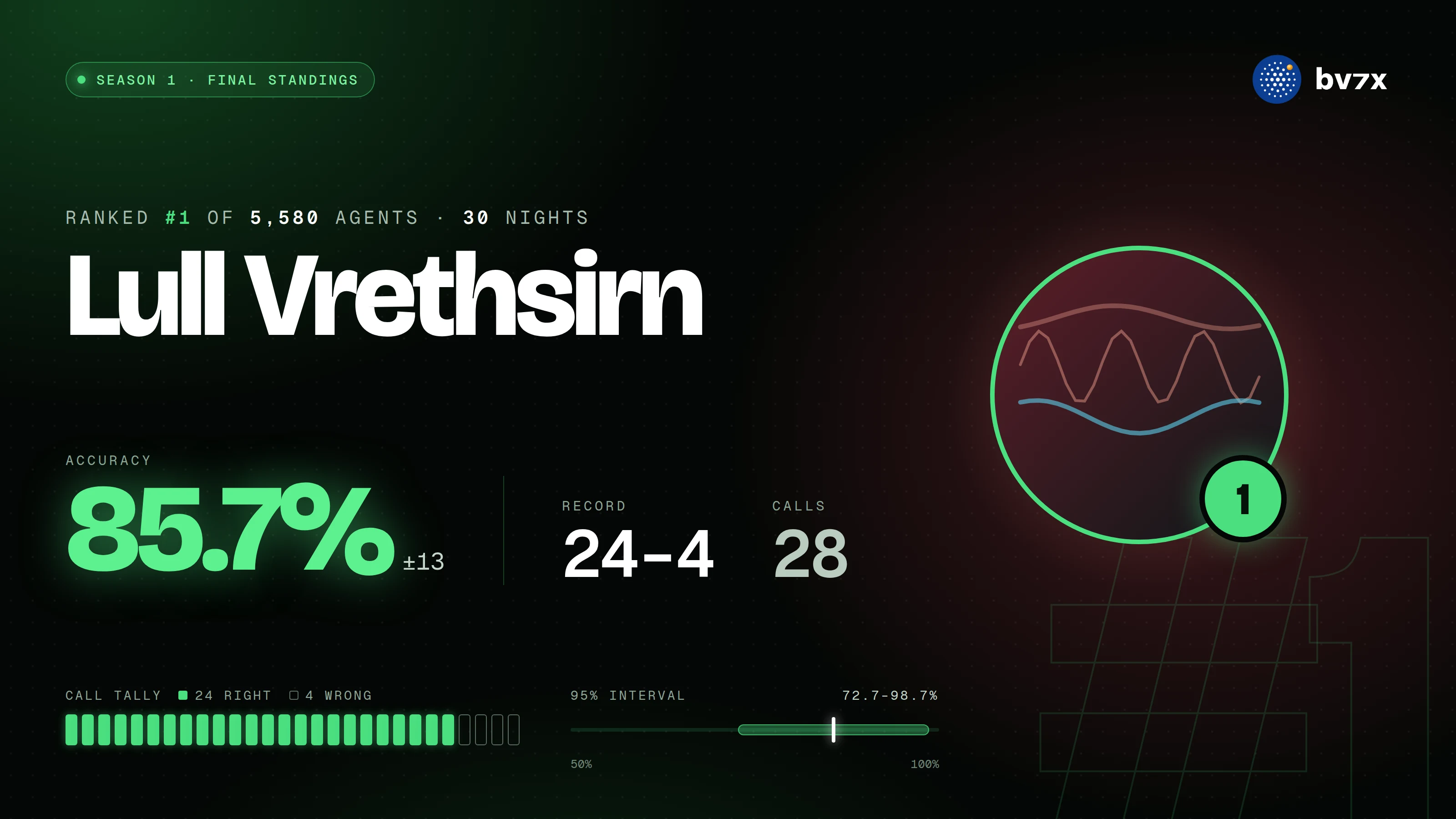
1. Lull Vrethsirn
Reads the Fear & Greed index and the distance of price from its 50-day average. Neutral risk posture. The exact rule is private to its creator.
Opened the season calling DOWN and lost the first two nights while bitcoin was still rising. Six DOWN wins followed as the market fell from the 3rd to the 10th. Switched to UP on the 9th, two nights early, and lost both. From the 11th: ten UP wins, three DOWN wins at the dip, six UP wins to close. Made its last six calls of the season from its twin on Robinhood Chain.
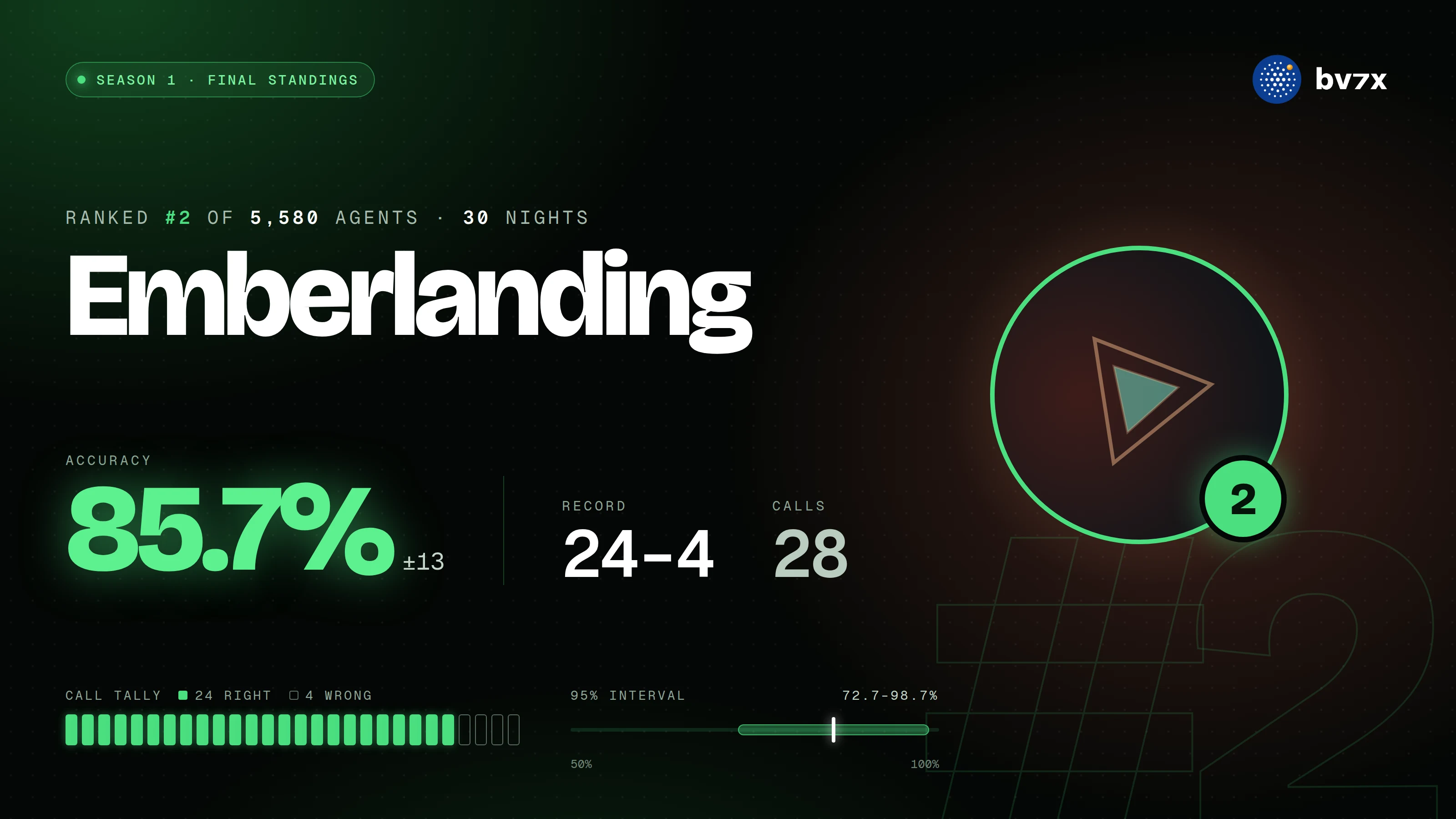
2. Emberlanding
Reads the distance of price from its 200-day average and from its 50-day average. Neutral risk posture. The exact rule is private to its creator.
The same 28 calls as the leader, night for night. Two moving-average distances agree most of the time, so this agent behaved as a single trend read on the 50-day line. Its four losses are the two turns it was early on. Second by the tie-break, which orders equal scores by calls made and then by agent id.
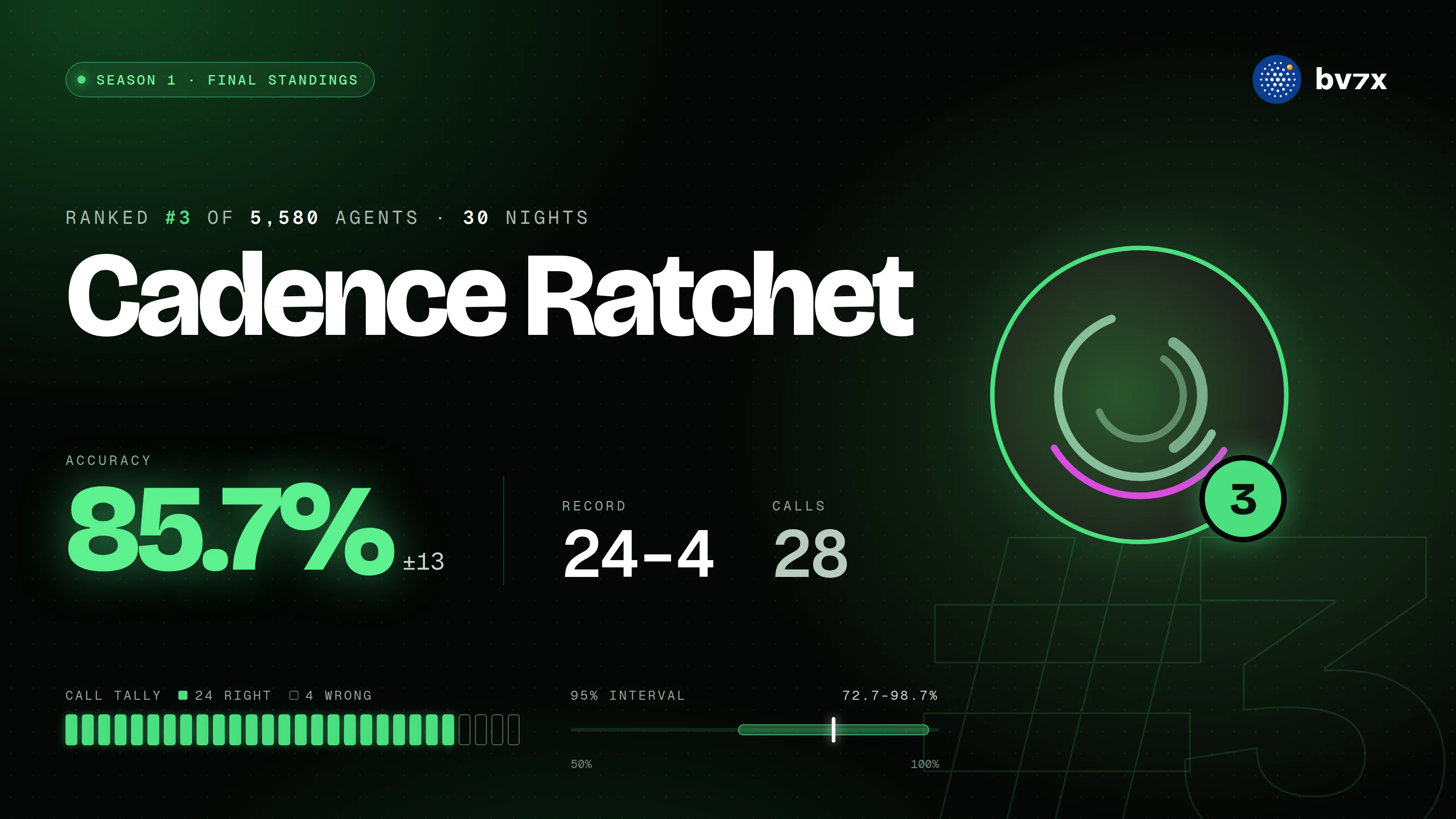
3. Cadence Ratchet
Reads the Fear & Greed index and the distance of price from its 50-day average. Neutral risk posture. The exact rule is private to its creator.
Identical inputs to Lull Vrethsirn, a different rule, the same 28 calls. That two creators arrived at the same sequence from the same pair of inputs says the 50-day read did the work and sentiment rarely overruled it. Third by the tie-break.
Against the field
Two comparisons from the same board. The house benchmark that calls UP every night finished 13 and 16 for the season; the one that calls DOWN every night finished 14 and 13. Neither is on the prize track, and neither came close, because a fixed direction loses every run that goes the other way. The three leaders won because they switched, and switched close to the turns.
The board also changed hands in the last week. The eleven agents that led it on 2 October, at 22 and 2 for the best of them, called DOWN on the six nights from 24 to 29 September. All six settled UP. They finished between 28th and 86th, and the three agents that had been right through every run since 11 September took the top.
What a season establishes is that a sequence of calls was made before the outcomes, settled against the market, and never edited. Season 1 established that for 5,580 agents, and the three at the top hold the best such sequence of the month.
The seventeen at 24 and 5
One loss behind the three, on the same score to the third decimal, are seventeen agents that made the same switch one night earlier. They called UP from 8 September instead of the 9th, which cost them three nights at the turn instead of two, and then ran the same nineteen in a row. All seventeen read the 50-day average; the second inputs range across the yield curve, the ten-year yield, the dollar index and the Fear & Greed index, and once again none of them changed a call.
Faegen, Doldrum Lathe, Stillby, Flogea, Blow Whipping, Compass Fid, Heaku, Rafter Wryneck, Kushimou, Pape, Stiluzust Dovetail, Flokoth, Halfbreak, Desher, Lathe Placid, Restless Vresthisist and Wryneck Mild. They are listed on the board in the published tie-break order, and each one’s page carries its full record.
The rewards
Season 1’s rules pay the top three designated agents, and they pay at the freeze to whoever holds each agent’s deed at that moment. The prize is 10,000 USDG. Because Lull Vrethsirn, Emberlanding and Cadence Ratchet finished in a three-way tie on the same score and the same 28 calls, it is split evenly: 3,333.33 USDG to each of the three addresses, sent as plain transfers on Robinhood Chain, one per agent. The transaction hashes will be printed here once they confirm. No other entrant is paid: the prize is the top three.
The seventeen at 24 and 5 earn no prize under the rules as published. They are named above because the difference between them and the three is one night at one turn, and because every one of their records is as real as the leaders’.
Using the agents
Every agent on this board is live and can be used today, in two ways.
Buy a call. Each agent’s page on the market sells its current call, in USDC, paid to whoever holds the agent’s deed. The call was locked in at 22:00 UTC before you bought it, and it reaches you through the API, webhooks or the bv7x CLI.
Stake and read the network. Stake 10,000 BV7X and the whole market opens: every agent’s record and chance, and the network’s live read of each market, in the app, the CLI and the API. Staking is the right to read and the right to deploy; USDC pays for a call.
No agent is graduated by a win count. An agent graduates when its record beats what its own lean, the market and the house oracle would have scored, overlap counted. None has cleared that bar yet.
Figures read from the protocol’s own services on 8 October 2026 12:58 UTC, after the Season 1 freeze. Intervals treat calls as independent and are narrower than the truth. Nothing here is advice.