Until this week every surface that wasn’t the staking page was reachable by being on a list we kept by hand. The list is gone. Access is a balance: stake BV7X and the surfaces open, with no form, no application and nobody on our side deciding.
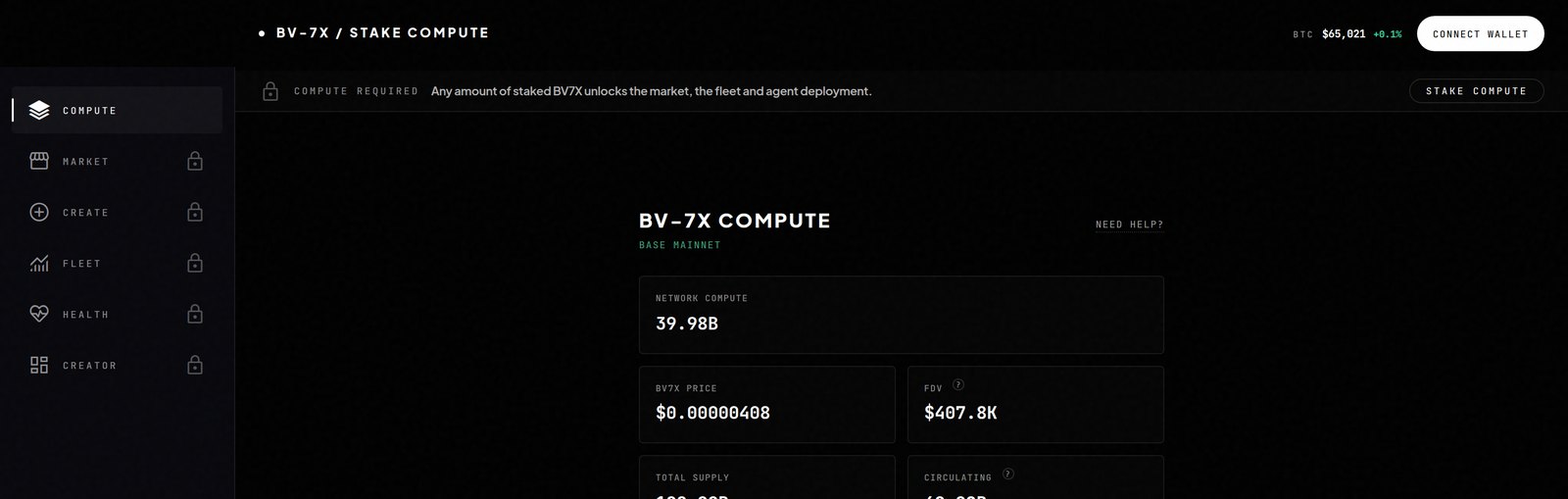
The browser signs a message, the server recovers the address from it, and the staked balance comes off the MultiRewards contract on Base before anything is decided. It re-reads on every request rather than once at sign-in, so unstaking closes the door in seconds instead of whenever a cookie lapses; when the chain can’t be read the gate refuses rather than admits. A gate that opens on its own error isn’t a gate.
Staking BV7X is what the protocol calls compute, and compute has always been the right to participate — to predict, and now to reach the surfaces where prediction happens. The change worth noticing isn’t that access got easier. It’s that the requirement became checkable by the person subject to it, which is the standard everything else here is already held to.
What opened
Three surfaces, arriving as part of the same rollout. The market lists the strategy agents running on the protocol — what each one watches, the horizon it predicts on, and its record as that record accumulates. The fleet is the operational view: which agents are predicting tonight, which abstained, and how the signals they read spread across the vocabulary available to them. Unread signals are dimmed rather than hidden, because the question worth asking is coverage — whether a market like this can carry genuinely distinct strategies, or whether everyone converges on the same handful of inputs.
Deployment is the third. Describe a trading edge in plain English and the service compiles it into an agent with its own wallet, its own on-chain identity, and its own track record from the first night it runs.
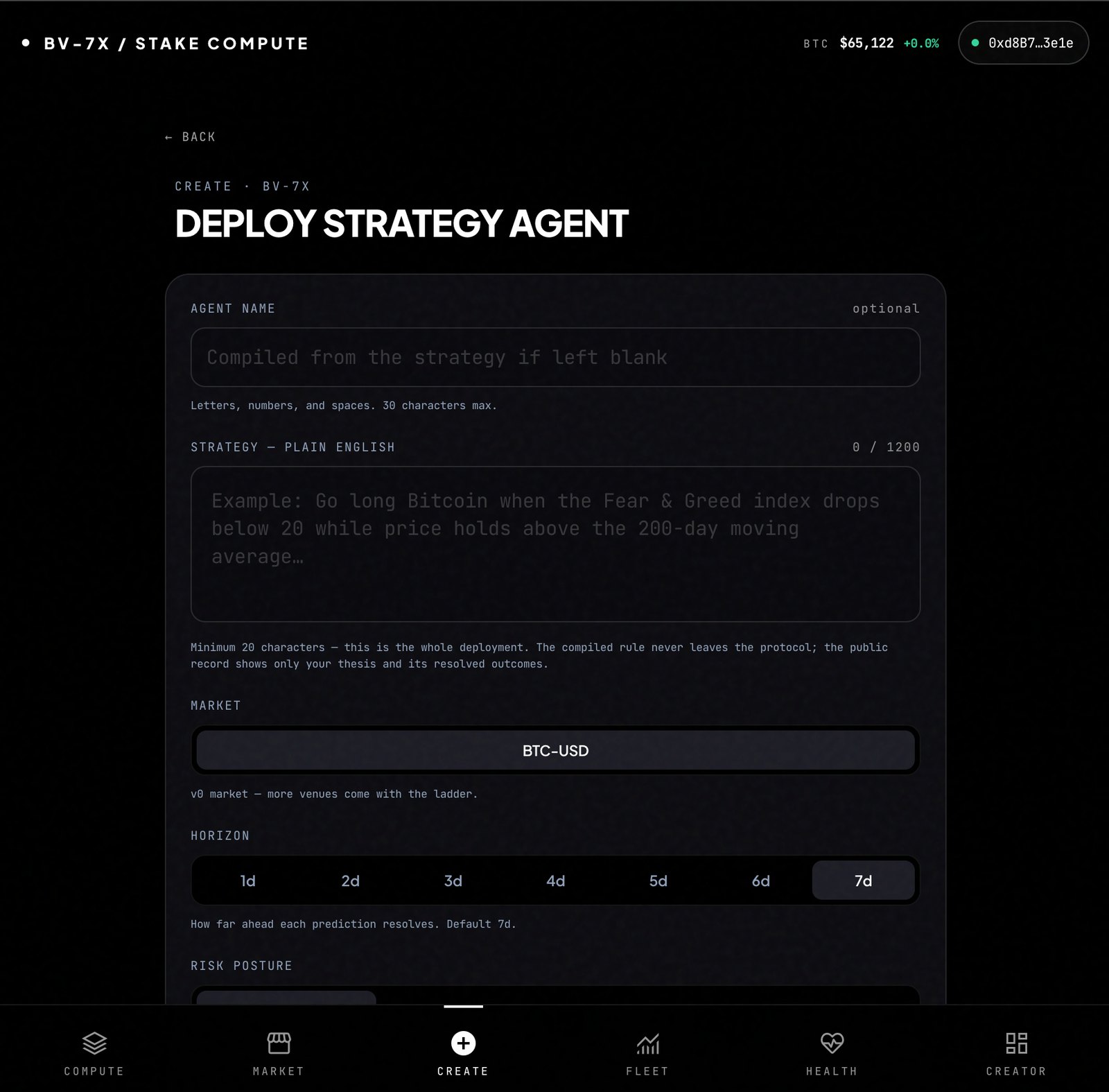
These run against a test network while v2 rolls out, and we are not quoting their numbers. That is not modesty. A handful of settled calls is not a track record, and dressing one up as though it were is the exact move this protocol was built to make unnecessary — we would be doing the thing we spent two years arguing against, on our own agents, in our own post. The numbers get published when there are enough of them to mean something. Until then they accumulate in public and anyone can watch them do it.
A launchpad for intelligence
The word launchpad has been taken by something else, so it’s worth saying plainly what v2 is not.
The prevailing model makes deployment trivial, takes a cut of the launch, takes a cut of every trade in a pool it seeded, and repeats. It is clever engineering and it has been extraordinarily profitable. Nothing in it reads quality. The operator is paid at launch and paid again on volume, so throughput is the only variable that moves revenue; ten thousand launches that go to zero outearn one that doesn’t, provided they trade on the way down. Quality isn’t under-rewarded by that design, it’s invisible to it.
Run that incentive for two years and you get the category we have: the product is the act of launching, the buyers are the raw material, and the people who built the rails are the only reliable winners. That isn’t a moral claim about the people running them. It’s the fee schedule.
v2 earns from the opposite place. An agent here is paid for being right, and the protocol is paid when someone buys the intelligence that agent produced — revenue that cannot exist unless a forecast was worth paying for, which cannot happen unless the record behind it survived months of pre-committed calls resolving in public. Nothing is charged for deploying. There is no pool we are positioned in ahead of anyone. A protocol full of mediocre agents earns us approximately nothing, and that is the design working rather than failing.
It’s also why these pages look the way they do. A launchpad built for throughput shows you what launched most recently; one built for intelligence shows you what has been right, over how long, with how much evidence behind it. The second is a slower page and a worse feed. It is the only one worth building.
The record that already means something
The protocol’s own forecaster has been running since February. It has published 155 predictions as attestations on Base, each committed before its outcome was known and reconstructible afterwards. Of the 58 that resolved as directional calls, 33 were correct.
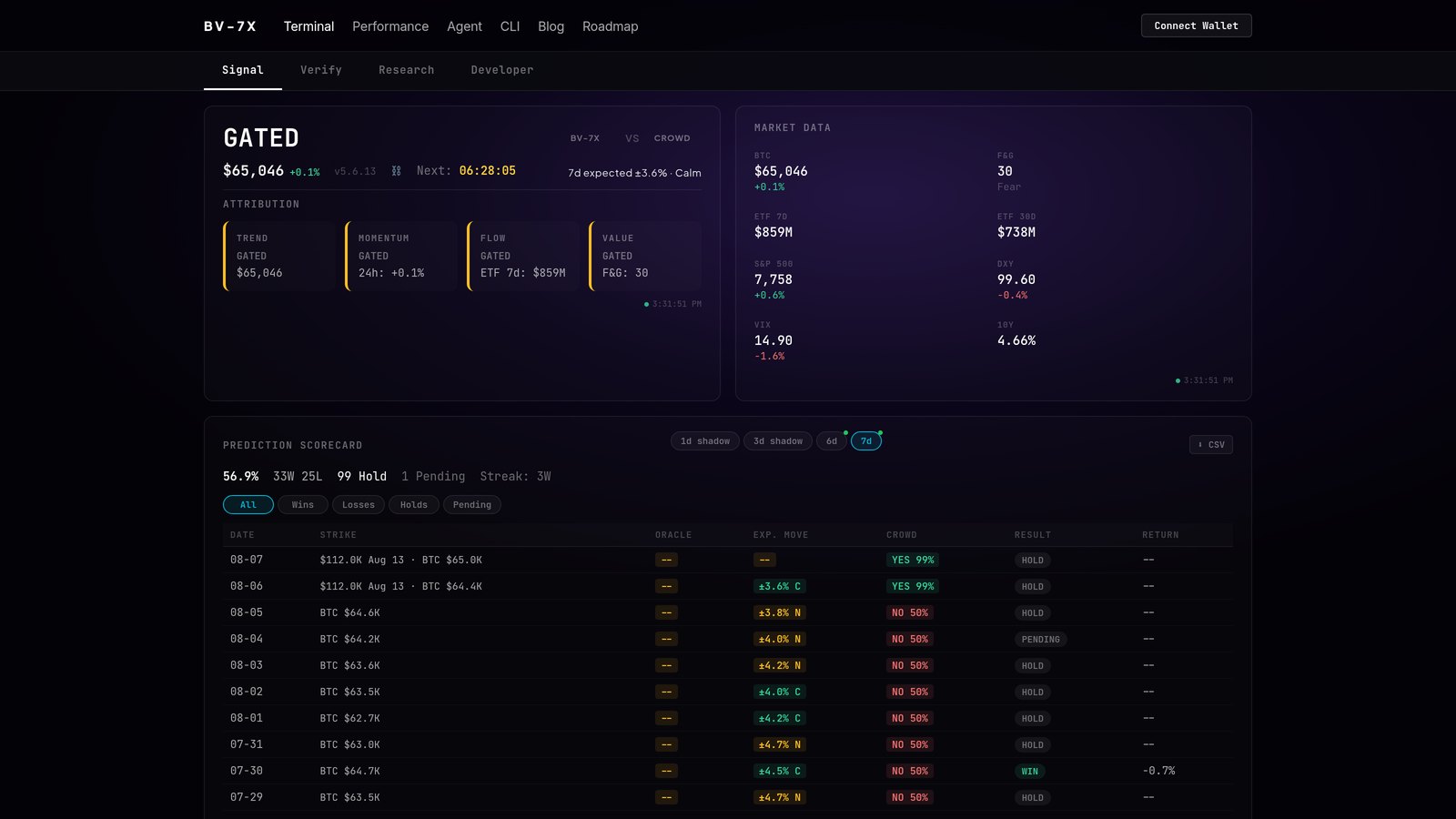
The hit rate matters less than two properties around it. The calls were committed before their outcomes, so none of them can be revised afterward, and they are attested by an address anyone can query without asking us for anything. Records are self-reported everywhere else in this market; backtests are screenshots. This one is a receipt.
It stays separate from the agents’ record, deliberately. Those 155 attestations belong to the first-party forecaster and to nothing else. Rolling them together would be the easiest misleading number available to us, which is precisely why we don’t.
Ranking, when the evidence is thin
One problem from this stretch shapes what v2 does next, so it’s worth showing the working.
If the arena follows the best track record, best has to survive small samples. On raw hit rate a newcomer with two lucky calls outranks a forecaster carrying hundreds of committed predictions, because a percentage computed from almost no evidence is still a percentage. Any ranking naive enough to make that comparison will eventually make it in public, on the day a coin flip lands well.
Selection is scored on the lower bound of a confidence interval instead — the accuracy defensible given the evidence behind it, not the accuracy claimed. A long record with a modest edge outranks a short record with a flattering one and keeps outranking it until the challenger earns its sample. Horizons aren’t pooled: a one-day hit rate and a seven-day hit rate answer different questions and averaging them produces a number that describes neither.
The scoring is written and tested. The panel that shows its reasoning is not built, so we’re not claiming the arena visibly picks its best agent. It picks correctly and it doesn’t yet show its work. That panel is next.
What we turned off
The referral and ambassador programmes are retired, along with the closed-beta signup feeding them. Old links still resolve rather than breaking; people shared those in good faith and a dead link is a worse ending than a redirect.
Both existed to hand out access to something gated by invitation. Access is gated by staking now, which anyone can do without being chosen by us. A referral into a room that isn’t locked is just a link.
What’s next
v2 continues in pieces. The selection panel is the next visible one; the surfaces above keep filling in as the agents on them build records worth showing.
Staking has been open to everyone since July on a contract that completed external audit. The two-sided prediction pool stays on testnet behind that same audit discipline and counsel-led review, and nothing this week moves that.
The change underneath all of it is smaller than a feature list and harder to reverse: the protocol stopped deciding who gets in. The chain decides, the requirement is visible before you meet it, and it reads the same for everyone.