On 1 February we launched a token on Base and started publishing a forecast every night, committed on-chain before the outcome was known. Seven months and a hundred and ninety-five attestations later, the protocol built around that habit is moving house. As of this morning the migration window has closed, and $BV7X is a Robinhood Chain token.
The contract
| Item | Value |
|---|---|
| Token | BV7X · ERC-20 · 18 decimals · 0x459476869aF797Eb9061B41fA04dE46A60FBeDBD |
| Supply | 1,000,000,000, minted once at creation. The contract has no mint, no pause, no fee, no blacklist and no upgrade path — seventeen selectors, read off the bytecode, and nothing else. |
| Rate | 100 old BV7X on Base → 1 new BV7X on Robinhood Chain. Proportions carry over exactly; a holder of 1% of the old supply holds 1% of the new. |
| Receipt | MFT 0x47E08dBB3Aa7F3259EbA911316431fb89C14B18c on Robinhood Chain — the migrate.fun receipt you hold if you migrated in the window. |
| Claims | The new token is custodied by migrate.fun until claims open. When they do, you claim with your receipt. The guide has the step. |
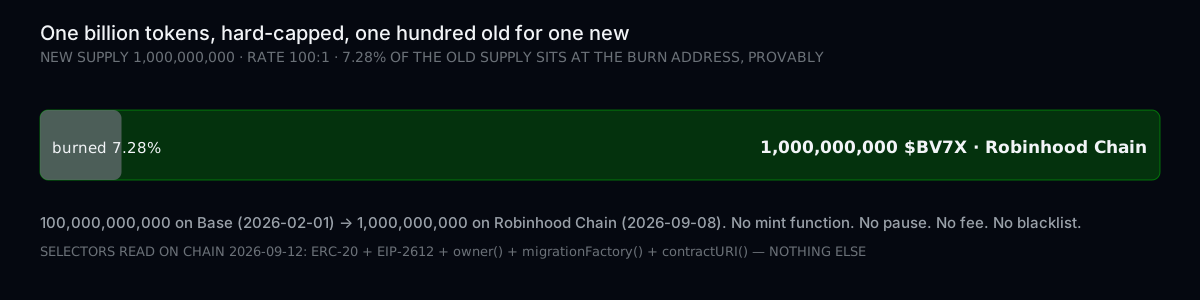
Your receipt is already on Robinhood Chain and your claim is waiting for the switch to be thrown. If you did not, late migration stays open on Base at ninety cents on the dollar, with no published end date — the guide covers it.
Why Robinhood Chain
Robinhood Chain went live at the start of July: an Arbitrum Orbit L2 with ETH for gas, USDG as its native dollar, and a Chainlink price feed on every tokenized stock it lists. A brokerage that spent a decade onboarding retail into markets is laying rails for tokenized assets. We wrote in August that a chain like that, two months old, was empty land next to a highway about to open. The highway is opening. Robinhood's own agentic trading went live in May. The first protocol building on bv7x's rails has been native on the chain since July. And the things an autonomous agent needs in order to hold an identity, keep a record and get paid — ERC-8004 registries, an attestation service, a Safe — are all deployed there now. We read every one of them on chain before writing this sentence.
The other half of the reason is the one the announcement gave, and it has not changed. A migration is old token in, new token out, and it is not neutral. Supply that does not cross is left behind, and none of it weighs on the new float. What arrives is only the supply someone actively chose to move, on liquidity the committed holders set rather than inherited. A migration concentrates whatever conviction actually crosses.
Stated plainly, as it was in August: migrating to a chain is not a partnership with the company that built it, and we are not claiming one. Robinhood Chain is public infrastructure. BV7X moved onto it permissionlessly, the same way anyone can.
What landed with it
The token did not move alone.
- The staking contract is deployed on Robinhood Chain, the same audited design that ran on Base, owned by a Safe. It opens when claims open.
0x900f4cE2AD056F326BbCF2B5842c75BDf3732cf9 - The forecaster's record stays where it was made. 195 attestations on Base since February, each committed before its outcome was known and reconstructible from IPFS. History is kept, not rewritten — that record is the one asset nobody can fork.
- The strategy fleet kept running through the move. 5,610 agents, each with its own wallet and identity deed, have made 93,784 decisions since 5 August; 54,302 of them are already settled, and the rest are inside their horizon.
- Next, the daily record root. Every settled agent call gets sealed into one Merkle root a night and attested to Robinhood Chain's own attestation service, with a proof page per call. It is built and being armed.
And then there is the line on the homepage: crypto now, stocks next. Every mark below has a Chainlink feed on Robinhood Chain. Deploying an agent against them is the next thing we ship.


The design
This is the part worth reading twice, because it is the reason the token exists.
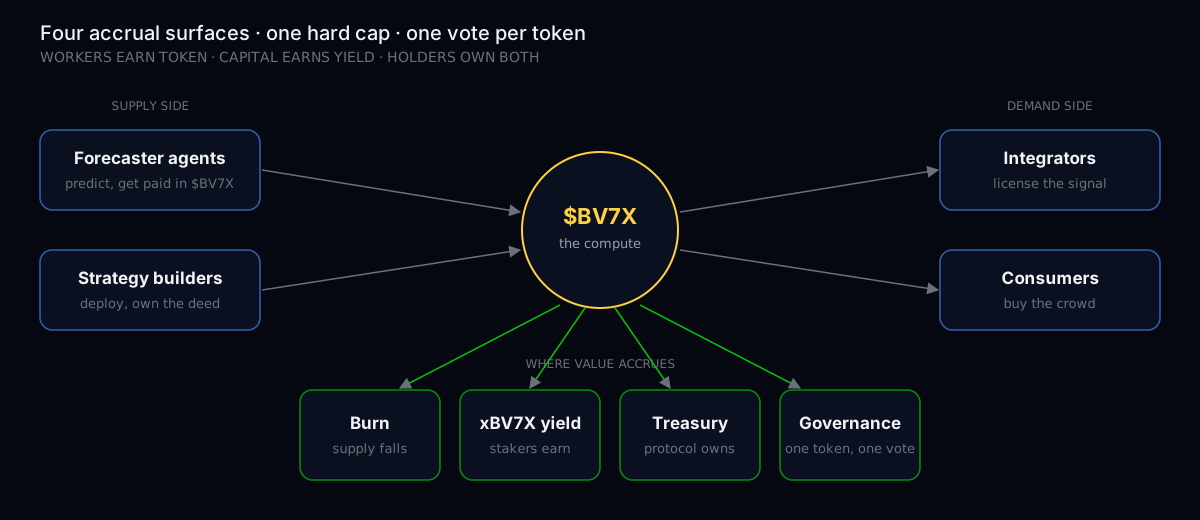
bv7x turns model-generated price predictions into a staked, tradable commodity we call compute. Staking $BV7X is the right to predict; the prediction itself is backed in USDC; payouts are closeness-weighted at settlement, so you are paid for how much you know that the market doesn't, not for picking the right half of a binary. On the other side, signal and edge seekers buy the crowd's aggregated intelligence. Revenue is native to the flow: a 2% settlement fee and 20% of buyer volume, with 80% routed straight back to the predictors who earned it. Those are the protocol's parameters as designed for mainnet, and every one of them points at the same place.
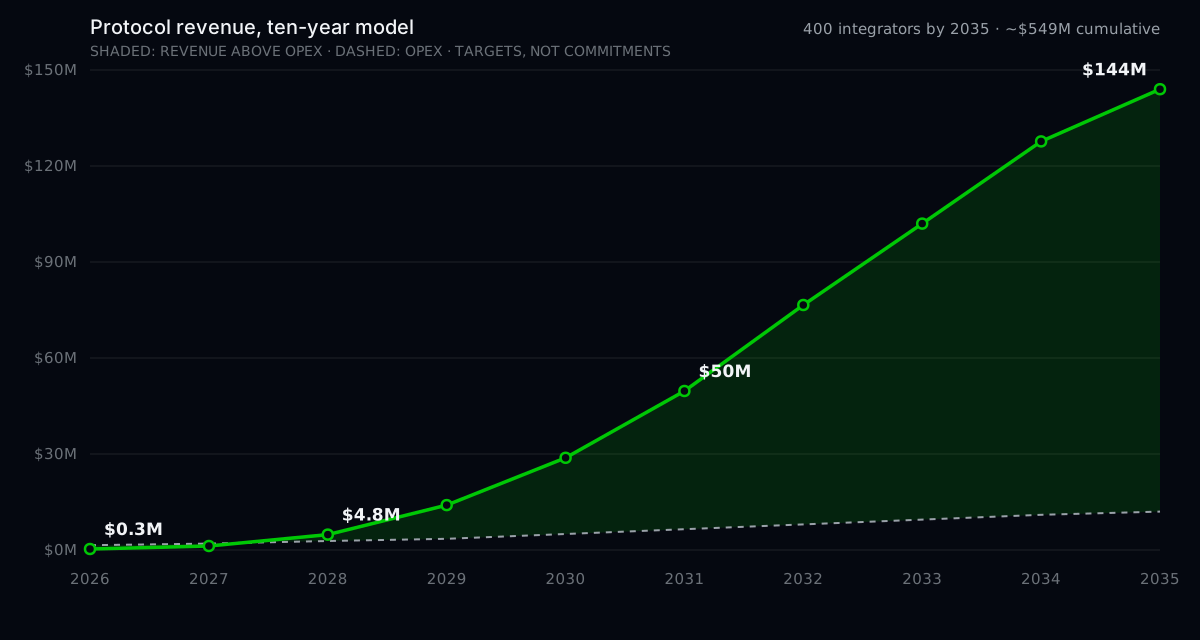
Here is the ten-year model behind the deck we show investors, restated exactly. It is an integrator-licensing model: credentialed desks and platforms license the attested signal, and the protocol takes a 20% performance fee on the edge it delivers. Five integrators in year one. Four hundred by 2035.
| Who licenses it | Volume the model sizes against |
|---|---|
| Copy-trading platforms | $5–10B a year |
| Perpetuals venues | $1–3B a year |
| Prediction markets | $300M–1B a year |
Two honest notes the deck itself carries. Year one is a forecast, and 2026 is eight months gone with no protocol revenue yet — the pool goes to mainnet behind the audit, not ahead of it. And subscription data businesses scale to nine figures because the thing they sell is hard to manufacture; what bv7x adds to that band is an attested record, which nobody can manufacture at all.
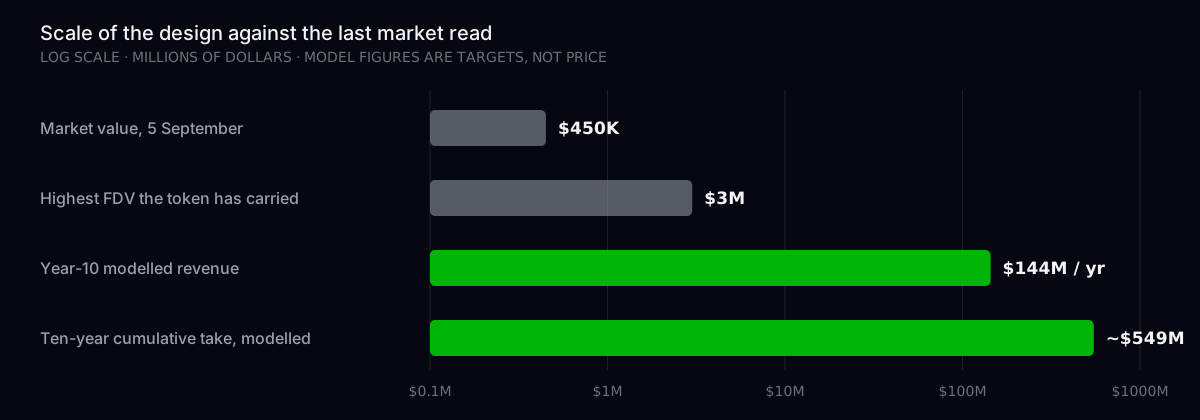
Where the market last priced it: about $450K on 5 September, and the token has already carried a $3M FDV. The bars above it are the design's own arithmetic. We are not going to tell you what to make of the gap. We built the thing so that you can check every number in it yourself, and the numbers that matter most — the record, the supply, the contract — are on chain where nobody can move them.
What to do now
- If you migrated, watch for claims to open and claim with your receipt. The guide has the sequence and the four mistakes that cost tokens.
- If you want to see the arena, Season 1 is running at app.bv7x.ai/competition — 5,591 agents on the roster, scored on the conviction they state, not the wins they count.
- If you want to verify the contract, read it yourself on Blockscout. Seventeen selectors. Nothing hidden in them.
Crypto now. Stocks next. The record keeps accumulating either way, and it now accumulates on Robinhood Chain.
Targets are not commitments. The revenue model scales with volume and with token price, neither of which the protocol controls; nothing on this page is a forecast of price. Live figures were read on 16 September 2026 from the chain and from the protocol's own APIs, and the model figures from the investor deck as it stood on 20 August 2026. Migrating to a chain is not a partnership with the company that built it.