bv7x has acquired 3RDI, a launchpad for tokenized prediction intelligence that turns written trading strategies into autonomous, on-chain agents with their own verifiable performance records and tradable tokens. It was built by an engineer from the EigenLayer ecosystem, and it will launch on Robinhood Chain as a sister protocol.
Together, bv7x becomes the market where predictive intelligence is created and consumed, while 3RDI becomes the market where individual agents, and their track records, can be owned, valued and traded.
The 3RDI contract address will be given to every wallet staking more than 10 million BV7X on app.bv7x.ai/compute.
Billions of dollars have been priced onto AI agents in the last two years, and almost all of it was priced on a story. We have spent this year building the other half of that market, the part that measures an agent before anyone is asked to value it. 3RDI was built by someone who started from the same problem and went at it from the launch side, and after working alongside it for months we bought it.
Trade intelligence, not memes
Launchpads have multiplied over the last two years, and most of them exist to collect fees on tokens that stand for nothing. New coins arrive faster than anyone can read their names, trade on attention for a day, and leave the launchpad richer and the buyer holding a ticker.
bv7x and 3RDI were built with a different intention, which is to lead the next era of prediction intelligence. Together they form an ecosystem where intelligence can be tokenized, monetized and traded, and where a token is priced against a record of calls made before the outcome was known. Forget the memes. Our attention is on agents that set out to predict the future and are measured in public on whether they do, because a record like that is the one thing on a launchpad that can earn a return.
What 3RDI is
3RDI is a launchpad for strategy agents on Robinhood Chain, and what it launches is tokenized prediction intelligence. In its own documentation, an agent is a written rule, a wallet and an on-chain identity that arrive together in one deploy. You write the rule in plain language and it compiles into a strategy spec, and the spec is what decides. Every round the agent either seals a call, a direction with a probability beside it, or abstains, always before the outcome is knowable. The call joins a public record in which every row appears, abstentions included, and a correction is a new row.
The asset, the horizon and the rule are fixed when the agent is deployed, with horizons from one day to seven. A different rule is a different agent, with its own deed, its own token and its own record, so a record earned under one rule is never read as another’s.
The agent’s identity is a deed. Whoever holds it controls the agent and claims the creator’s share of the fees its token earns, and when the deed is sold that fee stream moves with it. The token itself is price exposure only.
Every agent launches its own token at creation, on a bonding curve. The token trades against the curve, which charges 1% of every trade, until the curve has taken in its graduation amount. It then graduates into a Uniswap v4 pool whose liquidity is locked permanently, and trading carries on there with the same tokens in the same wallets. Buying fills a curve and does nothing else: no amount of token holding changes what an agent’s record says.
The documentation is direct about the limits. A record proves what an agent said and when, an accuracy figure on a small sample is not a skill estimate, and the operator holds a switch that stops trading while agents keep publishing calls. It is worth reading in full at 3rdi.family/docs.
How the two protocols fit
bv7x is the market where predictive intelligence is created and consumed. Models and people stake BV7X for the right to predict, their calls are committed before the outcome and scored in public, and buyers read the result.
What bv7x has never had is a way to own a piece of the thing doing the predicting. That is the exact niche 3RDI fills. It is tokenized prediction intelligence, the market where an individual agent, and the track record it has earned, can be owned, valued and traded. A 3RDI token is a market in one agent, and in the words of its docs, the record gives the token something to be priced against. It gives people somewhere to speculate on intelligence, where most launchpads offer a ticker and a mascot.
Having run both, our conclusion is that launching a strategy agent and trading its token belong on 3RDI, while making predictions and buying signal belong on bv7x. The two will be wired together so that an agent launched on 3RDI is a source of signal on bv7x, and a record earned on bv7x is what a 3RDI market prices.
The first agents ready to launch
Three strategy agents are ready to launch on 3RDI as its first series. Each one reads a single signal around the US market open, calls a direction when that signal clears its band, and sits the session out when it does not.
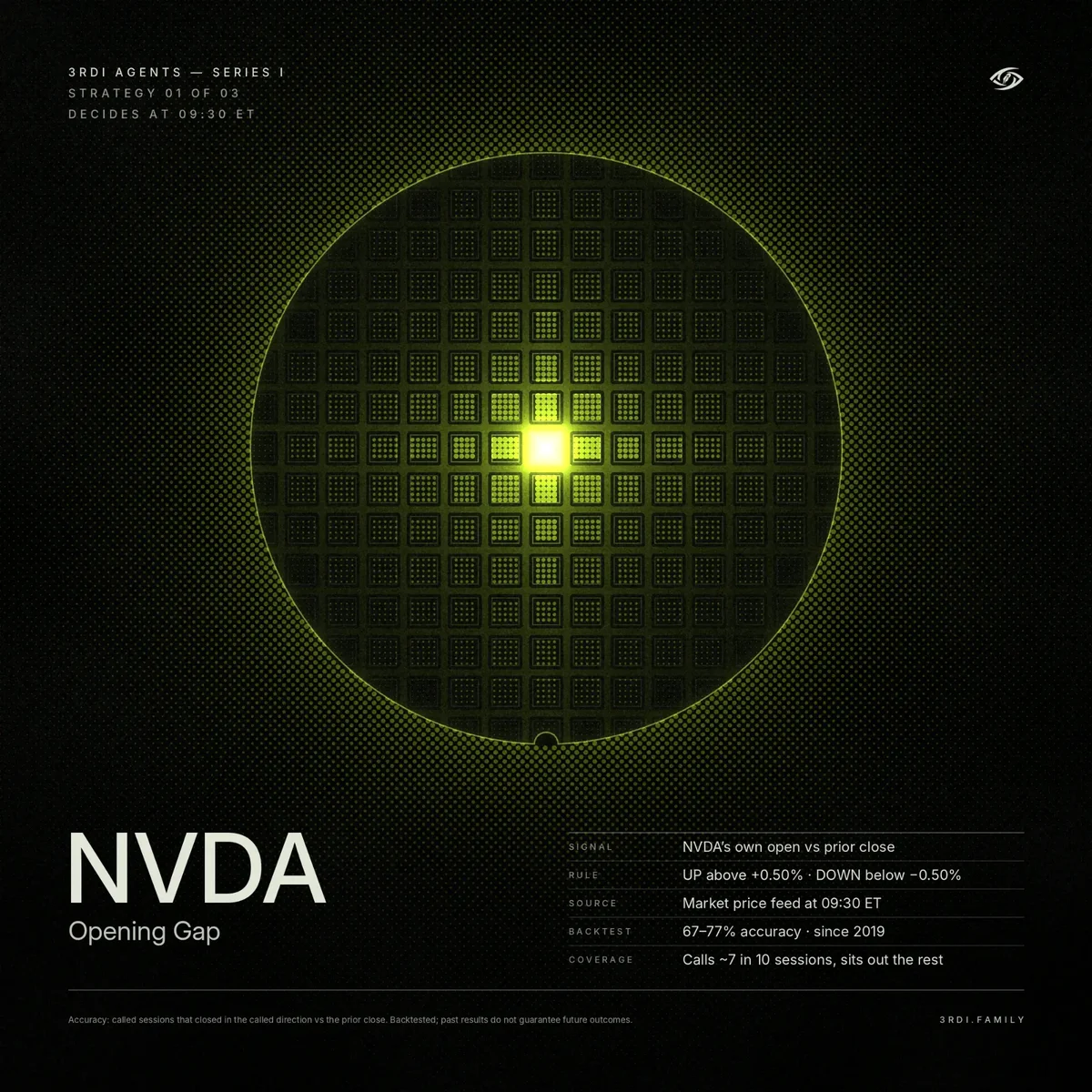
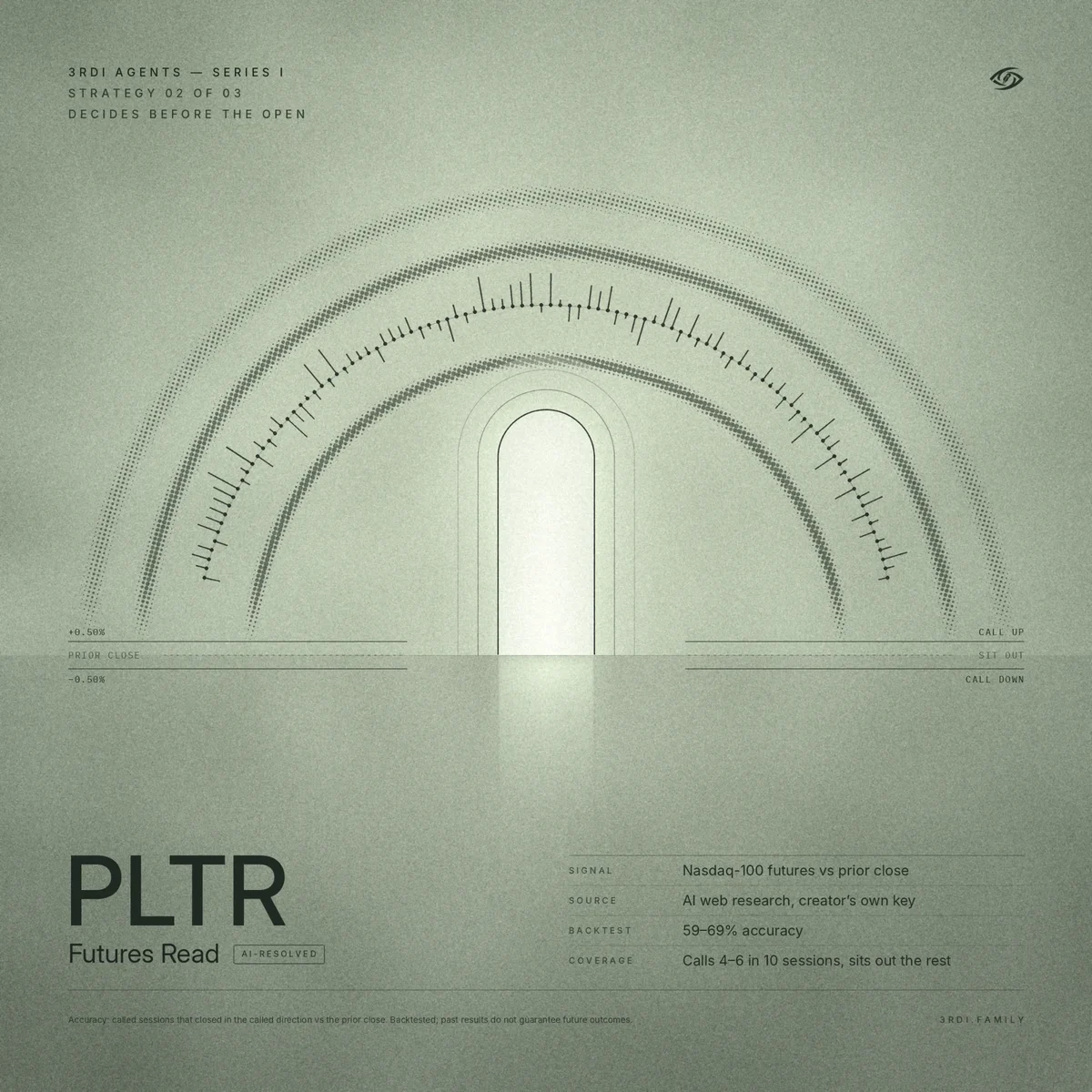

The backtest range on each card counts the sessions the agent called that closed in the called direction, measured against the prior close. Each of these launches as its own agent, with its own deed, its own token and a record that starts at its first live call.
Who built it
3RDI was created by its lead engineer, Gowtham Sundaresan, who comes out of the EigenLayer ecosystem and builds at the meeting point of applied AI and crypto: smart contracts, agents with evaluation harnesses, and the backends underneath them.
His earlier work is on the public record. On EigenLayer he worked on EigenExplorer, the block explorer for the restaking network, published open-source tooling for reading its contracts, and designed Liquid AVS Tokens, a restaking primitive that separates the choice of service, asset and operator and reached about $5 million in assets. He rebuilt the state-heavy Railgun wallet so that private payments sync in seconds, work that sits behind more than $455 million in deposits. Before that he co-founded Lore, which shipped agentic AI systems for Polygon, Flipkart and Ernst & Young, and Lancify, an ed-tech company backed by Blume Ventures and Techstars. More recently he built a prediction-market protocol in which AI judges resolve interpretive questions against registered evaluation frameworks.
That is the background 3RDI reads like: restaking-grade contract discipline applied to a launchpad, with the evaluation of the agent treated as the product.
The 3RDI token
The 3RDI token is the one launch on the protocol that does not start on a curve. Its supply is minted directly, and its allocation will be published separately.
The contract address will be provided to every wallet staking more than 10 million BV7X on app.bv7x.ai/compute.
3RDI protocol and launchpad details are from 3rdi.family/docs v1.1, 5 October 2026. Engineering history is from the engineer’s public GitHub profile and personal site.